

Medicare Advantage · 2027 Star Ratings · October 2026
CMS raised the score needed for 4 stars on 17 of 40 measures in the 2027 Star Ratings. A rate that earned 4 stars last year may earn only 3 now. Here is where the bar moved, and what it means for the gaps you can still close before December 31.
For Medicare Advantage leaders in Stars and quality · 4-minute read
What changed
Every year, CMS sets "cut points": the score a plan needs on each measure to earn 1, 2, 3, 4 or 5 stars. We compared the 4-star cut points in the 2026 and 2027 Star Ratings for the 40 measures that appear in both years. (We left out the two improvement measures, which work differently.)
The bar went up on 17 measures. It stayed the same on 13 and went down on 10. [Calculated]
Most of the increases were in Part C, the health side: 13 of the 17. [Calculated]
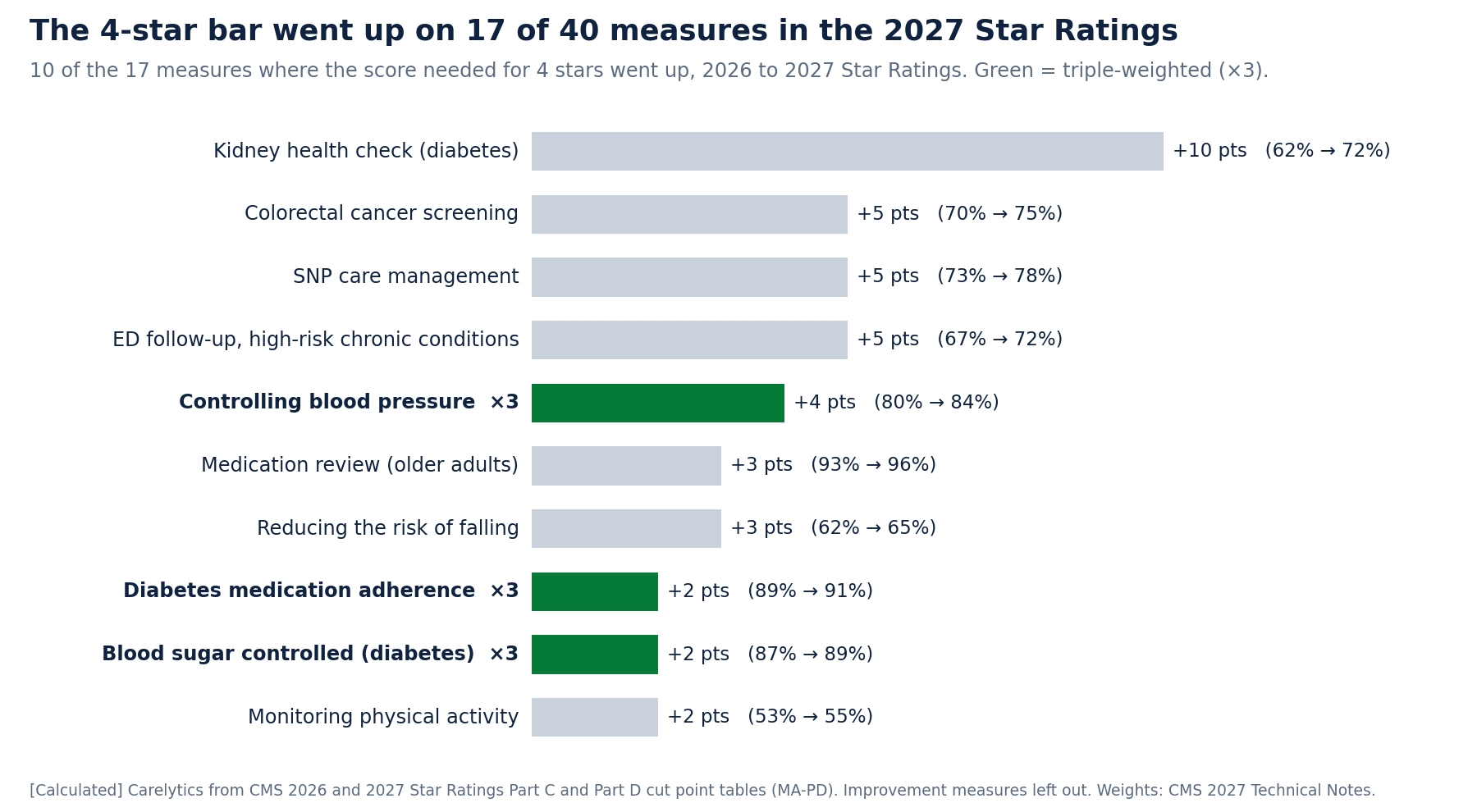
Three triple-weighted measures got harder. Controlling blood pressure went from 80% to 84%. Blood sugar control for members with diabetes went from 87% to 89%. Diabetes medication adherence went from 89% to 91%. [Calculated]
The biggest jumps
Kidney health checks for members with diabetes: up 10 points, from 62% to 72%. [Calculated] This measure is only in its second year in the Star Ratings. CMS limits how far a cut point can move in one year to 5 points, but that limit does not apply to measures that have been in the program 3 years or less. [Sourced: CMS]
Colorectal cancer screening, care management for special needs plans, and follow-up after an emergency room visit: each up 5 points. [Calculated] Five points is the most CMS lets most measures move in one year. [Sourced: CMS]
Why it matters
A measure's stars depend on where a plan's rate lands against the cut points. When the bar goes up and a plan's rate stays the same, its stars on that measure can drop. Triple-weighted measures count three times as much as most process measures in the overall rating. [Sourced: CMS]
Most HEDIS measures in the 2027 Star Ratings count care given in 2025. In the 2028 Star Ratings, they will count care given in 2026, and that year closes on December 31. [Sourced: CMS] We don't know the 2028 cut points yet. But if the trend holds, a plan that just met the bar in 2025 needs a higher rate in 2026 to keep the same stars.
What plans can do before December 31
Check your 2026 rates against the 2027 cut points, not last year's. Start with the measures where the bar moved most.
Rank members by the gaps that move a rate across a cut point. Closing a gap on a triple-weighted measure near the line is worth more than one far from it.
Reach members while there is still time. Kidney health checks, colorectal screening kits and refills can all be done before the year ends.
More on the year-end deadline: Why the weeks before December 31 set your 2028 Star Rating.
Where Marples fits
Marples finds each member's open care gaps using NCQA HEDIS standards and ranks the members to reach first. Members get secure texts in their preferred language and can request refills by text. Your care management team reviews any message with clinical details before it goes out. See how Marples works for health plans.
How we counted: Carelytics compared the 4-star cut points in the CMS 2026 and 2027 Star Ratings Part C and Part D cut point tables (MA-PD), matching measures by name. "Bar went up" means a higher score is needed (or, for measures where lower is better, a lower one). Sources: CMS 2027 Star Ratings data tables; CMS 2027 Star Ratings Technical Notes (cut point limits and measure weights).
